Types of Journal Articles
Types of Journal Articles
- Empirical
- Case study
- Review
- Theoretical
- Applied
Empirical
- An empirical article is a formal, scholarly research paper that presents and discusses original findings derived from direct observation or experimentation. Its core purpose is to contribute new knowledge to its field by providing evidence-based answers to specific research questions.
- grounded in data collected from the real world
“实证性文章”是一种正式的、学术性的研究论文,主要呈现并讨论通过直接观察或实验所得出的原创性研究发现。其核心目的在于通过为特定研究问题提供基于证据的答案,向所属领域贡献新的知识。
基于从现实世界中收集的数据
e.g.
- The Impact of Social Media Usage on Adolescent Mental Health: A Longitudinal Study
- Evidence of Microplastic Accumulation in Urban Riverine Food Webs: A Stable Isotope Analysis
- 城市河流食物网中微塑料积累的证据:一项稳定同位素分析
Case study
- Descriptions of an individual situation in detail, identify characteristics, findings, or issues, and analyze the case using relevant methodologies or theoretical frameworks.
- 对个体情境进行详细描述,识别其特征、发现或问题,并运用相关方法论或理论框架对该案例进行分析。
e.g.
- Tesla’s Market Disruption: A Case Study on Innovation in the Automotive Industry
Review
- Summaries of other studies, identifying trends to draw broader conclusions.
- 对其他研究进行总结,识别其中的趋势,并据此得出更广泛的结论。
e.g.
- Systematic Review of Microsurgical Techniques for Peripheral Nerve Injury Repair: A Meta-Analysis of 65 Cases
- 显微外科技术修复周围神经损伤的系统综述
- a comprehensive overview of the past, present, and future
- current research status and future directions
Theoretical
- Scholarly articles regarding abstract principles in a specific field of knowledge, not tied to empirical research or data.
- 关于某一特定知识领域中抽象原理的学术文章,不依赖于实证研究或数据。
e.g.
- Revisiting Foucault’s Power-Knowledge Nexus in Digital Surveillance Societies
- 重审福柯的“权力-知识”关联:数字监控社会中的理论再探
Applied
- Real world techniques, workflows etc. This type of article is generally found in trade / professional journals which are aimed at a professional audience rather than an academic one.
- 现实世界中的技术、工作流程等。这类文章通常见于行业期刊或专业期刊,其目标读者是专业人士而非学术群体。
e.g.
- Implementing AI Chatbots in Customer Service: Efficiency Gains and Ethical Challenges
- 人工智能聊天机器人在客户服务中的应用:效率增益与伦理困境
Key characteristics of academic English
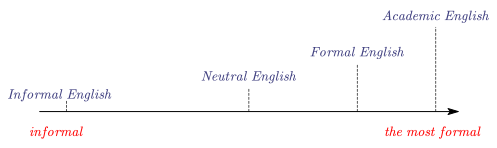
- Informal Casual, conversational tone. Use contractions and simple words. 语气随意、口语化,使用缩略形式和简单词汇。
- Neutral Balanced, clear but not overly strict Avoids slang but keeps readability. 风格平衡、清晰,但不过分严肃;避免俚语,同时保持可读性。
- Formal Professional and structured Uses full words (cannot instead of can’t) and passive voice. 风格专业、结构清晰,使用完整形式的词语(如 cannot 而不是 can’t),并常使用被动语态。
- Academic Most formal, technical, and precise Avoids personal opinions, uses specialized terms, and follows strict conventions. 最正式、最具技术性且最精确;避免个人观点,使用专业术语,并遵循严格的写作规范。
Key characteristics of academic English:
- Formality
- Academic writing avoids informal language, contractions (e.g., “won’t,” “it’s”), and slang, opting for more formal vocabulary and sentence structures. 学术写作避免使用非正式语言、缩略形式(如 “won’t”“it’s”)和俚语,而倾向于采用更正式的词汇和句子结构。
e.g.
- The results show (informal)
- The results indicate (formal)
- Objectivity
- It focuses on facts, evidence, and arguments rather than personal opinions or feelings, often using the passive voice to emphasize information rather than the writer. 它侧重于事实、证据和论证,而不是个人观点或感受,并且经常使用被动语态,以突出信息本身而非作者。
e.g.
We put the plants in a really cold room, and it was obvious they didn’t like it at all. (informal)
The experimental group exposed to 5°C exhibited a mean growth rate reduction of 60% compared to the control group maintained at 22°C. Chlorosis was observed in 80% of the specimens, and a significant decrease in biomass was recorded. (formal)
- Specialized Vocabulary
- The language includes field-specific terminology and jargon, allowing for nuanced and accurate communication within a particular academic discipline. 这种语言包含特定领域的术语和专业用语,从而能够在某一学科内部进行细致而准确的交流。
- facilitate precise communication and avoid ambiguity in specialized fields. 这些术语有助于实现精确表达,并避免在专业领域中产生歧义。
- Complex Sentence Structure
- Academic English often uses longer, more complex, and grammatically intricate sentences, including subordinate clauses. 学术英语常常使用更长、更复杂、语法结构更为严密的句子,包括从句。
- Precision and Accuracy
- Words are used with their specific, narrow meanings, avoiding vague terms and ensuring that facts and figures are presented precisely. 词语通常按照其特定而狭义的含义使用,以避免含糊表达,并确保事实和数据得到准确呈现。
e.g.
- The experiment worked well, and the results were good. (informal)
- The experiment achieved a 95% success rate (n=50), with results statistically significant (p<0.05) compared to the control group. (formal)
- Explicitness and Cohesion
- Being explicit means being unambiguous, leaving no room for implied meaning. 明确性(being explicit)是指表达清楚、没有歧义,不给隐含意义留下空间。
- Being cohesive means the relationship between different parts of the text is made clear through linking words and phrases, which helps to guide the reader through the argument. 连贯性(being cohesive)是指通过连接词和连接短语清楚地展现文本不同部分之间的关系,从而帮助读者理解论证过程。
e.g.
- Many people want to help the environment. They recycle paper and plastic. It is not enough. Carbon emissions are very high. Factories should change their ways. Individuals can also drive less. (informal)
- Many people want to help the environment by recycling paper and plastic. However, this alone is not enough to solve the problem. The biggest challenge remains high carbon emissions, which are largely produced by factories. Therefore, industrial practices must change. At the same time, individuals can also contribute by driving less. (formal)
- Referencing and Citation
- Evidence and examples are always supported with references to other sources, clearly indicating where the information originates. 证据和例证通常都会以其他文献来源作为支撑,并清楚标明信息的出处。
- Cautious Tone
- Writers use tentative language (e.g., “it is possible that,” “may,” “could”) to express ideas with appropriate caution and avoid making absolute claims. 作者会使用试探性语言(如 “it is possible that”“may”“could”)来以适当谨慎的方式表达观点,并避免作出绝对化的断言。
e.g.
- There is a correlation between social media use and sleep disturbances, but further research is needed. (×)
- The data suggest a potential correlation between social media use and sleep disturbances, but further research is needed. (√)
- Nominalization
- Use of abstract nouns for conciseness.
e.g.
- We analyzed the data and found trends. (verb-heavy). (×)
- The analysis of data revealed trends. (nominalized) (√)